

Advanced Sacroiliitis Relief Near Helotes, TX | Restoring Mobility on Wiseman Blvd
At San Antonio Pain Consultants, Dr. Darius Zagunis, MD, provides personalized sacroiliitis care for patients near Helotes, TX, who are experiencing lower back, hip, pelvic, or buttock discomfort. By carefully evaluating each patient’s symptoms, movement limitations, and overall health, our team develops a customized treatment plan focused on reducing inflammation, improving joint function, restoring mobility, and supporting greater comfort during everyday activities. For more information, contact us today or book an appointment. We are conveniently located at 3903 Wiseman Blvd, Ste 117, San Antonio, TX 78251.
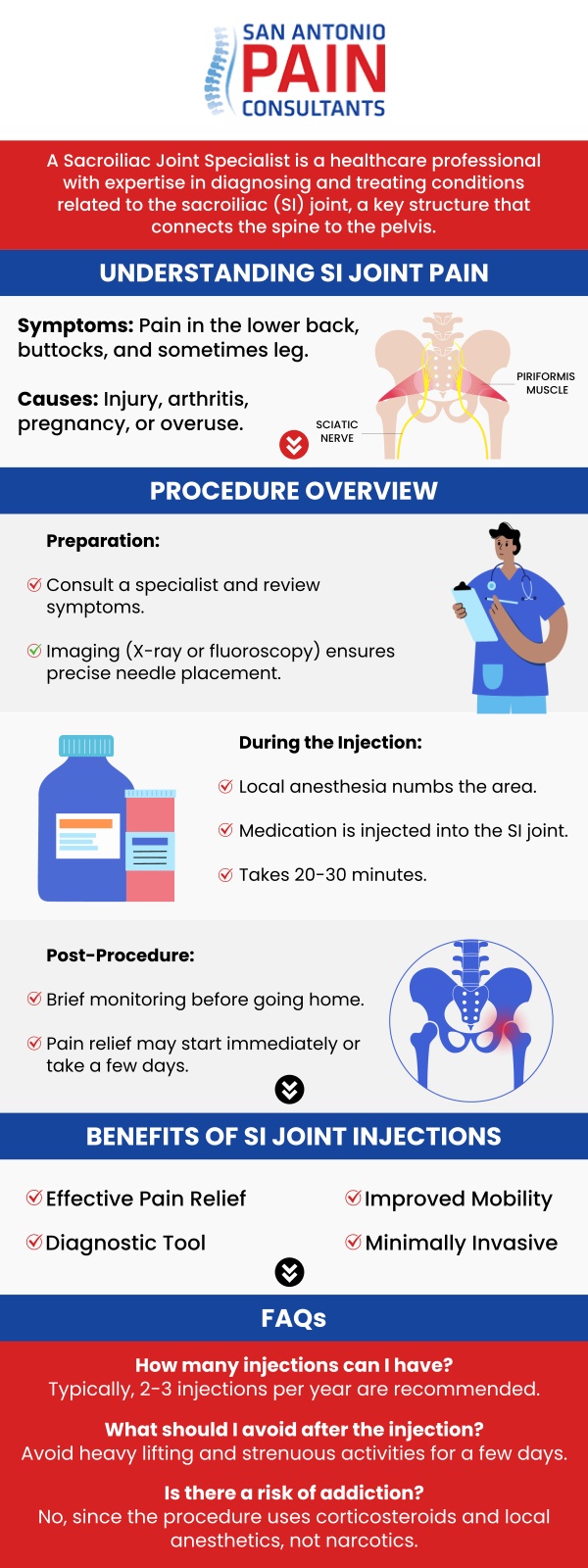
Table of Contents:
How does sacroiliitis develop within the sacroiliac joint?
What role does the sacroiliac joint play in supporting the lower spine and pelvis?
What changes occur when the sacroiliac joint becomes inflamed?
Why may sacroiliitis lead to discomfort around the lower back and hip area?
What warning signs may suggest a sacroiliac joint issue?
Can sacroiliitis create discomfort while walking, standing, or sitting?
How can sacroiliitis impact flexibility and daily movement?
What symptoms indicate the need for professional sacroiliitis care?
What may trigger inflammation within the sacroiliac joint?
Are autoimmune or inflammatory conditions linked to sacroiliitis?
Can physical strain or changes in the pelvic area affect the SI joint?
Who may have a higher chance of developing sacroiliitis?
What steps are involved in assessing a patient for sacroiliitis?
How do providers evaluate sacroiliac joint pain and inflammation?
What diagnostic methods may be used to identify sacroiliitis?
How do specialists rule out other conditions with similar symptoms?
How can sacroiliitis symptoms be addressed through treatment?
Can movement-based therapies help patients with sacroiliac joint discomfort?
What options are available to support improved function with sacroiliitis?
How does individualized care help patients manage sacroiliitis?
Where can patients in Helotes, TX, receive advanced care for sacroiliitis from San Antonio Pain Consultants?
Sacroiliitis occurs when one or both sacroiliac joints become inflamed, causing discomfort in the lower back, buttocks, pelvis, hips, or upper legs. Symptoms may affect walking, sitting, standing, climbing stairs, or changing positions. At San Antonio Pain Consultants, Dr. Darius Zagunis, MD, provides personalized evaluations and treatment plans designed to reduce discomfort, improve joint function, and restore comfortable movement.
The sacroiliac joints connect the lower spine to the pelvis and help transfer weight between the upper body and legs. When these joints become inflamed, they may cause stiffness, tenderness, and pain during movement.
Sacroiliitis may develop when inflammation, arthritis, infection, pregnancy-related changes, or repeated physical stress affects the sacroiliac joint. Irritation within the joint can make weight-bearing and movement uncomfortable.
The sacroiliac joints provide stability, absorb physical forces, and transfer body weight through the pelvis and legs. They allow a small amount of movement during walking, bending, and changing positions.
When a sacroiliac joint becomes inflamed, tissues within and around the joint may become sensitive and painful. This irritation can cause stiffness, tenderness, reduced mobility, and discomfort when pressure passes through the pelvis.
The sacroiliac joints are located where the lower spine meets the pelvis, close to muscles, ligaments, nerves, and structures involved in hip movement. Inflammation may therefore produce localized pain near the lower back or buttocks and referred discomfort around the hip, thigh, or leg.
Possible warning signs include pain on one or both sides of the lower back, tenderness near the buttocks, morning stiffness, and discomfort that increases with prolonged sitting or standing. Patients may also experience pain while climbing stairs, taking long strides, turning in bed, or shifting weight from one leg to the other. Because these symptoms can resemble other back or hip conditions, a professional evaluation is important for identifying their source.
Walking, sitting, and standing place pressure through the pelvis. Symptoms may become more noticeable after remaining in one position, walking long distances, or placing uneven weight on the legs.
Pain and stiffness may make bending, rotating, exercising, getting out of bed, or rising from a chair difficult. Some patients may also change their posture or walking pattern to avoid discomfort.
Professional evaluation may be needed when pain persists, worsens, returns frequently, or interferes with sleep, work, walking, or daily activities. Sudden weakness, numbness, fever, or bladder and bowel changes require prompt medical attention.
Sacroiliitis may be associated with ankylosing spondylitis, psoriatic arthritis, reactive arthritis, Crohn’s disease, ulcerative colitis, and other inflammatory conditions.
Repetitive lifting, posture changes, leg-length differences, pregnancy, and altered walking mechanics may increase stress around the sacroiliac joint and contribute to discomfort.
People with inflammatory arthritis, inflammatory bowel disease, psoriasis, pelvic infection, pregnancy-related changes, or altered spinal and pelvic mechanics may have a higher risk.
The provider may review symptoms, health history, previous treatments, and activities that worsen the pain. The examination may also assess posture, walking, tenderness, strength, and range of motion.
Providers may use controlled movements to apply pressure to the pelvis and sacroiliac joints. Reproduction of the patient’s usual pain during several tests may suggest SI joint involvement.
Testing may include X-rays, MRI, CT scans, blood tests, or an image-guided diagnostic injection, depending on the patient’s symptoms and suspected cause.
Specialists compare examination findings with possible conditions such as sciatica, disc problems, hip disorders, muscle strain, fractures, or inflammatory disease.
Care may include activity modification, medication, physical therapy, home exercises, or image-guided procedures. Additional treatment may be considered when conservative care does not provide sufficient relief.
Targeted exercises may improve flexibility, strengthen supporting muscles, and promote more balanced movement. The program should be customized to avoid placing unnecessary stress on the joint.
Treatment options may include stretching, strengthening, medication, posture education, injections, radiofrequency procedures, or treatment for an underlying inflammatory condition.
Personalized care considers the cause of the condition, symptom pattern, physical limitations, health history, and mobility goals. Treatment can then be adjusted based on the patient’s progress.
Patients near Helotes can receive advanced sacroiliitis care from San Antonio Pain Consultants on Wiseman Boulevard in San Antonio, TX. Dr. Darius Zagunis, MD, evaluates the source of discomfort and creates an individualized plan focused on reducing pain, improving pelvic function, and supporting greater mobility. For more information, contact us today or book an appointment. We are conveniently located at 3903 Wiseman Blvd, Ste 117, San Antonio, TX 78251. We serve patients from San Antonio TX, Helotes TX, Alamo Ranch TX, Leon Valley TX, Shavano Park TX, Balcones Heights TX, Fair Oaks TX, Fair Oaks Ranch TX and Castroville TX.
Check Out Our 5 Star Reviews



Conditions We Treat
▸ Back & Spine Pain
▸ Herniated Disc Treatment
▸ Sciatica
▸ Neck Pain
▸ Knee Pain
▸ Arthritis Pain
▸ Arm & Shoulder Pain
▸ Abdominal & Pelvic Pain
▸ Headaches & Migraines
▸ Hip Pain
▸ Neuropathy
▸ Cancer Pain


 Send Text
 How May I Help You?